World Religious Peace ParliamentProposed International Institution

Draft instrument

Draft Constitution and Founding Charter.

Proposed for establishment in Italy. Entry into force follows approval by the Founding Council, signature by authorized founding members and completion of the legally required establishment procedure.
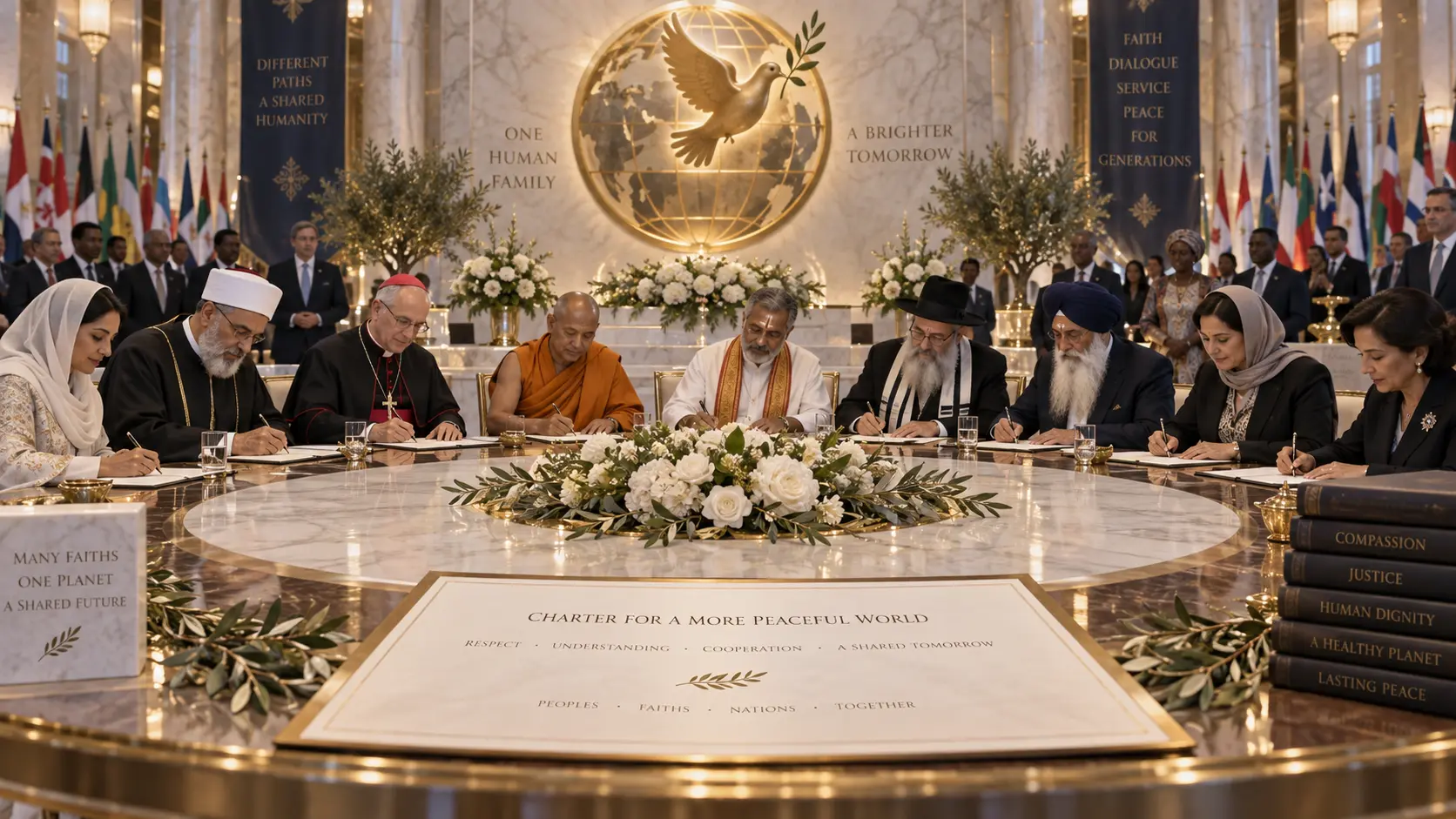
Representatives of many faiths signing a charter
Signing of the founding charter — concept

Preamble

We, the Founding Members of the World Religious Peace Parliament, recognizing the dignity of every human being and the importance of religion, spirituality, ethics, scholarship, dialogue and humanitarian cooperation in building peaceful societies, hereby establish this Parliament as an independent international platform dedicated to peace.

We acknowledge that humanity consists of many religions, traditions, cultures, nations and schools of thought, and that diversity should not become a cause of hatred, violence, discrimination or division.

The Parliament shall not seek to unify religions, alter doctrine, interfere in theological matters or place one belief system above another. Its purpose shall be to create a common platform for peace, dialogue, coexistence, humanitarian cooperation, education, reconciliation and the protection of human dignity.

One Humanity. Many Faiths. One Commitment to Peace.

The fifty articles

Articles 1 – 8

Identity and character

  • Name — World Religious Peace Parliament (WRPP)
  • Legal character — independent, non-profit, non-partisan, non-sectarian
  • Headquarters — Italy, with regional and liaison offices
  • Vision, mission, fundamental principles
  • Religious neutrality and political neutrality

Articles 9 – 14

Founding and executive offices

  • The Founder & Global Chairman as guardian of the founding philosophy
  • Founding Members recorded in the Founding Charter
  • Founding Council as the initial governing body
  • Secretary-General and Deputy Secretaries-General

Articles 15 – 28

Assembly, membership and councils

  • The Assembly as the primary global forum
  • Thirteen membership categories, eligibility and code of conduct
  • Supreme Council of Religious Leaders; Advisory and Research Councils
  • Women's Peace Council, Youth Parliament, Humanitarian and Mediation Councils
  • Government participation, international organizations and institutional partners

Articles 29 – 39

Sessions, decisions and reach

  • Annual Global Assembly and extraordinary sessions
  • Committees and consensus-based decision-making
  • Limits on doctrine; peace declarations and their adoption status
  • The World Religious Peace Declaration
  • Digital Parliament, official languages, national chapters, regional offices

Articles 40 – 50

Integrity, independence and entry into force

  • Lawful funding, financial transparency and donation safeguards
  • Conflict of interest, Ethics Committee and removal of members
  • Institutional independence — no owner of the Parliament
  • Amendments with heightened protection for core principles
  • Dissolution, international development and entry into force

Founding members

All final legal documents will contain each founding member's complete legal name, nationality and official designation. Additional founding members may be admitted with the approval of the Founding Council.

Syed Ali

Initiator, Founder & Global Chairman

Signature

Alberto

Founding Member

Signature

Marko

Founding Member

Signature

The final instrument includes the date, the place of signing in Italy, the founding members, their signatures, witnesses and the official institutional seal.