Proposed development framework
A phased roadmap with measurable milestones.
Five phases, beginning with legal structuring in Italy and progressing only as readiness allows. All future dates are indicative unless officially confirmed, and treaty-based standing remains a possible long-term ambition subject to sovereign-state agreements.
Development stages
Phase 1
Establishment in Italy
Incorporation under an appropriate Italian legal structure, with a Founding Charter, Constitution and Statutes, Founding Council, registered headquarters, governance system, membership regulations, ethics and compliance framework, financial and auditing procedures, and an international advisory structure. At this stage the institution describes itself as an international peace and interfaith institution, not an IGO.
Phase 2
Global religious membership
Appointment of respected religious representatives worldwide: 100 founding and senior international representatives, expanding to 250, then 500, and a long-term target of 1,000 Global Religious and Peace Representatives drawn from recognized religious communities, academic institutions and peace organizations.
Phase 3
Government engagement
A participation track for states that is separate from religious membership: observer governments, supporting states and partner states, each defined so that religious independence and national sovereignty are both preserved.
Phase 4
Treaty-based development
Should states choose it, a Treaty Establishing the World Religious Peace Parliament could define objectives, rights and responsibilities of member states, headquarters arrangements, governance, voting, financial contributions, accession, observer participation, dispute resolution, withdrawal, amendments and international legal personality. Any claim of international legal status will rest on actual legal recognition.
Global Peace Assembly
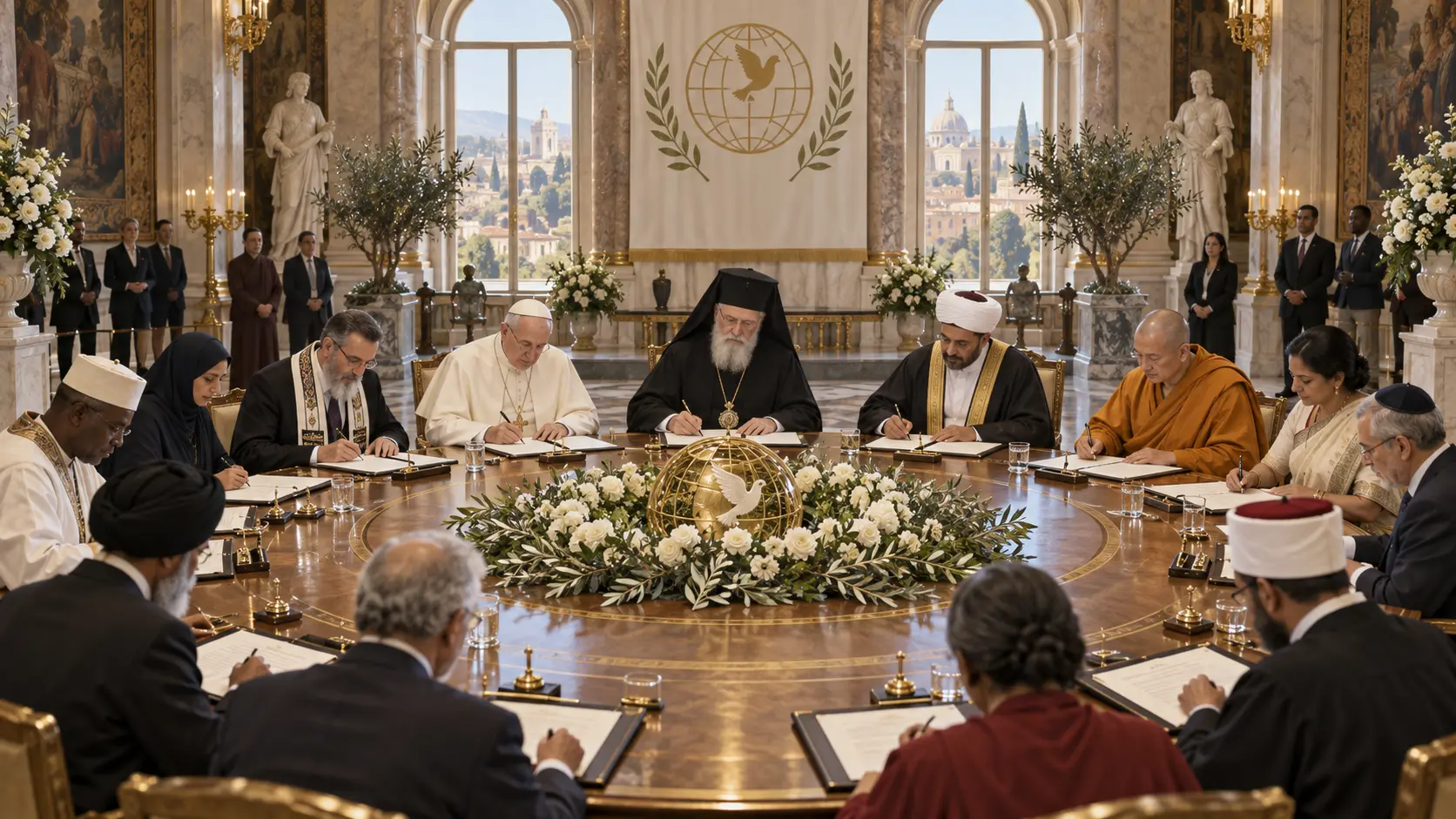
Once international participation is sufficient, Italy could host the World Religious Peace Parliament Global Assembly, eventually convening 1,000 religious representatives alongside government delegations, international organizations, academics, humanitarian bodies, youth representatives, women peace leaders and media.
Digital World Parliament
A secure digital parliamentary system so that a religious leader in Africa, Asia, Europe or the Americas may participate without always travelling to Italy.
- Attend international sessions remotely
- Participate in committees
- Submit peace proposals
- Review research
- Participate in approved votes
- Communicate with international members
- Access multilingual translation
- Join emergency humanitarian consultations
Ten-year ambition
More than conferences: a permanent international institution.
- 1,000+ religious and peace representatives
- Participating governments
- National and regional chapters
- Permanent international headquarters in Italy
- Annual parliamentary sessions
- A global research institute
- An international peace academy
- A humanitarian cooperation network
- A mediation and reconciliation centre
- A global youth parliament
- A women's peace council
- An international digital parliament
Religion will remain different. Humanity remains one. Peace must belong to everyone.
Five-year implementation plan
A disciplined build-up from legal establishment to global membership and institutional recognition.
Year 1
Registration in Italy, charter, founding council, first 50–100 representatives.
Year 2
250 members, first Global Assembly, digital parliament in beta.
Year 3
500 members, research academy, youth and women's councils operational.
Year 4
750 members, humanitarian alliance and mediation centre expanded.
Year 5
1,000 members, government observers, host-country and treaty discussions.
Funding and sustainability
Funding should strengthen independence — never purchase influence over religious representation.
- Founding contributions — registration, legal, charter and core setup
- Membership and events — annual assembly, forums, training
- Grants and philanthropy — research, education, humanitarian action
- Corporate responsibility — transparent, programme-specific support
- Campus development — separate project finance structure
- Publications and academy — courses, certification, research outputs
Donations may be refused where they could compromise independence, reputation, neutrality or legal standing. Annual accounts, authorized expenditure procedures, independent audit, conflict-of-interest rules and anti-corruption controls apply throughout.
How success is measured
The institution should be judged by practical peace outcomes, not only by conferences.
- Membership — verified leaders, scholars and institutions
- Dialogue — sessions held, communities represented, agreements reached
- Education — youth trained, curricula delivered, universities engaged
- Humanitarian — joint relief actions, volunteers, beneficiaries supported
- Research — reports, declarations, policy papers and publications
- Recognition — observer states, official partners, host-country progress
Next actions
Confirm the legal structure in Italy; finalize founding member details; prepare the charter and constitution; identify riverfront land; begin formal outreach using accurate partnership language.
Different beliefs. Shared dignity. Common responsibility.